BWFLI
  • Facebook
  • Home
  • Blogs
    • Brenda’s Blog
      • Brenda’s Blog
      • About Brenda A. Smith
    • Weekly Thoughts
    • Breakfast With Fred
      • What is Breakfast With Fred?
      • About Fred Smith, Sr.
      • Breakfast With Fred website
  • BWFLI Roundtable
    • BWFLI Launches the Roundtable
    • Introduction-Schedule-Bios
    • Ron Glosser-Fred Smith chapter
    • Perseverance Book
    • 200 Mentoring Questions
    • Jarvis College BWFLI poster
    • Alice Lloyd College poster
    • Lindsey Wilson College poster
  • Leadership Online
    • Leadership Team
  • About Us
    • What is BWFLI?
    • What is Breakfast With Fred?
    • About Fred Smith, Sr.
    • About Brenda A. Smith
    • Contact Us
  • Please Donate
    • Click Here to Donate
    • Why Give to BWF Project, Inc.?
  • Home
  • 2015

Straight and Crooked – Part Three

Weekly Thought – December 29, 2015

Fred valued intellectual integrity. Speakers who depended on emotional persuasion without the benefit of facts won little respect. He did the hard work of thinking about ideas and developing a system and framework for his worldview.

The year is ending. What a time of grateful reflection. We are deep into plans for our 2016 schools and the excitement is palpable. Please continue to partner with us in prayerful expectation. May your last days of 2015 give you ample opportunity for praise to our faithful and true God.

Straight and Crooked – Part Three

I was taught to go to church twice on Sunday. So when I moved to an area where they didn’t have Sunday evening services, I didn’t know what to do. I felt guilty. It took me a long time to work through this, getting to the point where I could say to Mary Alice, “It is okay to stay home.”

We need to be more honest with young Christians about that. For example, we tell new Christians to have a specific daily time for prayer and Bible study. That’s fine. But instead of laying it on as a duty, we need to explain the rationale. We need to sit down and explain: “You are new; here is a discipline you will find healthy. Most mature Christians take up a routine for reading the Scripture. At the least, it is good to set aside a daily time with God.” We must always remember God isn’t tied to our schedule.

We must be honest with people about what a discipline is, what a ritual is, and what reality is.

People are quite different in the way they can best approach Scripture. I went to a church where a mathematician was the leading elder. He was very strong on studying the Bible chapter by chapter, verse by verse – front to back. It just broke his heart to vary from this pattern. Others are equally strong in their beliefs and convictions, but prefer the method which applies scripture topically.

We must carefully counsel new Christians in this regard. After all, we are not on a point system with God. He wants us to know Him – not attempt to beat some hypothetical (and erroneous) score. We as older Christians (and hopefully more mature) must always seek to instill the importance of a relationship with God.

I was at a college in Florida where a medical doctor made the mistake of opening his speech by listing his doubts. He asked me later what I thought of his talk. I said, “I’ve found I have no right to give a group my doubts because when I find an answer, I can never get that group back together to finish the discussion. So while I live with my doubts, I only preach my beliefs.”

It is tempting to express your doubts, because it makes you feel comfortable and real. But it is much more helpful to focus on the positive. I remember a late night session with Baylor students, talking about the minimum you can do and still be considered a good Christian. One foreign student spoke up: “I’m not interested in the minimum; I’m interested in the maximum.” I suddenly realized she was the one with intellectual integrity. Those in the discussion were trying to get into heaven on the cheapest general admission ticket; she was in love with God.

This week think about: 1) How can I clarify the difference between discipline, ritual, and reality? 2) What is my counsel for new Christians? 3) When do I let intellectual integrity slip?

Words of Wisdom: “We must be honest with people about what a discipline is; what a ritual is; and what a reality is.”

Wisdom from the Word: “But set Christ apart as Lord in your hearts and always be ready to give an answer to anyone who asks about the hope you possess.” (1 Peter 3:15 NET Bible)

Read More

Stop, Look, and Listen

blog 58 stop look listen

Brenda’s Blog – December 29, 2015

“Will this be for here or to go?”

My friend stopped in a specialty bakery which features a small cafe. She picked up ten loaves of bread to be given as Christmas gifts. As she checked out, the question came to her, “Will this be for here or to go?” Think about that! She has 10 loaves of bread in her hands. How hungry could she possibly look?

When she laughed and said, “Did you really say that?” the service person merely stared at her.

How many times do we operate robotically? How often do we mechanically go through the day?

What if my friend had asked for a gallon of coffee and directions to the nearest open table? Would that have startled the cashier?

What does it take to shake us out of our automatic responses?

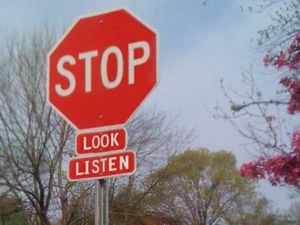
When I was in elementary school, we were taught “Stop, Look, and Listen” as we approached train tracks. I still do that!

In a scholarly essay, a University President pointed out we are quickly losing the art and science of listening. We reload while another speaks. We often miss the import and flow of a conversation by rotely forwarding our own points.

Trained responses are helpful. In sales much time is spent drilling on “power phrases.” Surely you have experienced the “Feel, Found, Felt” approach. But good sales people are also instructed in the power of listening.

The next time we encounter a person engrossed in a process and not personal relationship, think about my friend and her ten loaves of bread. And the next time we click our brain into neutral and utter some of our “go to phrases” without honestly listening, remember human interaction is important. A kiosk could ask her to click “here” or “to go.”

Stop, look, and listen – it matters.

Read More

Straight and Crooked – Part Two

Weekly Thought – December 22, 2015

Fred believed in identifying personal uniquenesses and focusing on their development. His ability to handle large quantities of information, distilling into essential parts helped others. He likened his process to putting handles on pots to make it easier movement. He said an idea needs a handle to pass it from one to another – one of his gifts was building handles.

BWFLI thanks you for your faithful encouragement. The 2016 schedule is complete and the planning is now in active mode. Please continue to pray for Lindsey Wilson College, Alice Lloyd College, Asbury University, and Palm Beach University.

Straight and Crooked – Part Two

In our comfort driven society, too many high profile church leaders allow the irresponsible to avoid discomfort. For example, if a thousand members are giving an average of two percent of income, success is declared. But this is way short of a true healthy congregation’s contributions.

It is tempting for the pastor to brag on the size of the budget as if everyone were doing what they should. Instead of talking about the irresponsibility of not giving sufficiently, too many pastors make them comfortable by talking about meeting the budget.

Throwing a spiritual mantle over the nonspiritual is a temptation for many leaders. This is also a serious downfall among the people, in general. “We have spent hours in prayer and we believe this is the answer.” If this is true, I am all for that statement. Too often, the decisions are made for political reasons and are based on human reasoning alone. Doing God’s work in man’s way is dishonest.

How many times do we promise to pray for someone when we have no genuine intention of doing so? That is harsh, isn’t it? Perhaps in the moment we intend to pray, or perhaps we just want to end the conversation. How about dropping God’s name? If I have been invited to speak at a prayer breakfast, I make sure my friends know. That way I get in one lick for God and two licks for me.

Here is a tough one: how about an organization that passionately preaches the imminent return of Christ while setting up a ministerial structure in perpetuity with all the accoutrements? I have often wondered how book publishers negotiate royalty contracts with people who expect Jesus to return within months. Do they put in contingency clauses?

Another concern is the common belief we are all children of God, regardless of our faith positions. I believe we are all creatures of God, and through the new birth, we become children of God. If we are all given the inheritance at birth, there is no need for the work of Christ. And if His work is unnecessary, so was His coming. Without His coming, we are still creatures, but very lost and without hope.

Think about this: 1) When am I tempted to “get in one lick for God and two for me?” 2) How do I respond to the temptation to make things comfortable when I should be challenging? 3) What areas in my life are out of balance?

Words of Wisdom: “Doing God’s work in man’s way is dishonest.”

Wisdom from the Word: “I know, my God, that you examine thoughts and are pleased with integrity. With pure motives I contribute all this; and now I look with joy as your people who have gathered here contribute to you.” (1 Chronicles 29:17 NET Bible)

Read More

Words Matter

blog-57-words-have-power

Brenda’s Blog – December 15, 2015

“Speedo Repair”…

The reader board caught my eye as I traveled through Dallas. I could see the small Speedometer store on the side of the interstate, but it didn’t interest me until… I saw their brief notice.

What do you think? Was that cryptic offer to rejuvenate out of kilter speedometers? Was that a humorous double entendre crafted to get attention?

The way we talk has influence and impact. We recognize accents, styles, and word choices. We make value judgments based on the vocabulary, articulation, and expressions.

When I was young my parents taught me swearing was lazy. When someone had to resort to improper speech, and vulgarities it was because of a lack in vocabulary options. As I got older and spent time with well-educated men and women, I realized coarse speech was more than lazy – it was habitual.

Precision in speech always gets my attention. The gift of having access to exactly the right word in the right place garners admiration. One of the sadnesses of older age is the evaporation of words. I know I used to know, but now I grasp for the proper word, usually settling for the lowest common denominator.

The Bible tells us our speech has the power to heal or to hurt. In Proverbs we are told the extreme quality of “an apt word.” The picture drawn is of “apples of gold in settings of silver.” That puts encouraging words in rarified air, doesn’t it?

Words are the way we connect ideas to action. Words are the bridges from one to another. Words matter.

Read More

Straight and Crooked – Part One

Weekly Thought – December 15, 2015

Fred once commented he liked to do “crooked thinking on the straight and narrow.” He highly respected the body of Christ and refused to take pot-shots at the church, even when offered opportunities by high ranking intellectuals. Leadership Journal published an article entitled Straight Answers in a Crooked Age which gave Fred a platform to express his quest for intellectual integrity in Christian leadership. We will do a series which covers all his points in coming weeks.

Straight and Crooked – Part One

Several years ago, I was talking with a former fundamentalist who had left the ministry to enter politics. I realized how far he had strayed from fundamentalism when he said, “You know, Smith, I respect your intelligence. How in the world can you still believe in authority of Scripture?”

I knew he would argue against a rational defense, so I took a different tack. “At one time in my life, I thought about taking your position because there was so much in the Bible I found distasteful. But then I realized it was my distaste rather than my disbelief that was causing the problem. I didn’t want to believe the parts of Scripture that commanded my actions. I didn’t want to lose control of my life making obedience more important than knowledge.”

He didn’t change his mind, but I think he went away respecting the fact that intellectual integrity could make you submit to Scripture.

Since then I’ve done more thinking on the subject. If I remove the portions of Scripture I dislike, and five of my friends do likewise, the six of us could pretty well scrap the whole book through our distaste for obedience, our rebellion against authority, and our worship of knowledge.

I know myself well enough to know I’m not God-like enough to be that authoritative. Honesty compels me to accept the authority of Scripture.

Intellectual integrity, however, is not abundant in the Christian community. In fact I find more of it in business than I do in religion. There’s a simple reason: business uses the language of figures. Politics, religion, and education don’t lend themselves to bottom line evaluation.

I will throw out several areas which are troublesome and later we will cover them in depth: 1) Spiritualizing the non-spiritual; 2) Operating from spiritual platitudes; 3) Confusing creatures of God and children of God; 4) Transposing knowledge and faith; 5) Policing the church, positively and negatively; 6) Turning reality into ritual and forced disciplines; 7) Setting the bar too low; 8) Pushing theology into boxes.

Humility is still the surest way to genuine intellectual integrity.

This week think about: 1) Where are my struggles with integrity? 2) Who best knows my soft spots? 3) What am I doing to grow into a whole person?

Words of Wisdom: “Honesty compels me to accept the authority of Scripture.”

Wisdom from the Word: “The one who conducts himself in integrity will live securely, but the one who behaves perversely will be found out.” (Proverbs 10:9 NET Bible)

Read More

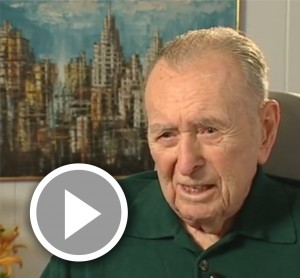
Fred Smith Sr. shares a lifetime of Encouragement at Centennial Celebration

Fred-Smith-Sr-shares-lifetime-of-EncouragementClick here to enjoy Fred Smith Sr. and his lifetime of encouragement.

Read More

Sin Talk

Weekly Thought – December 8, 2015

Fred, during one of his hospital stays, called a number of friends to say goodbye. As expected these were emotional conversations. Fred ended each one with an expression of affection, adding “remember I am just a sinner, saved by grace.”

The teams are forming for the 2016 BWFLI schedule. The campus venues are coming together. And, throughout the process, we are trusting God for providential work. If you want to help us financially, we will be most grateful.

Sin Talk

We are so afraid of minimizing sin we find it difficult to accept forgiveness for fear we will begin to enjoy sinning. We set up the test of a Christian as one who sins, but does not enjoy it. “He cannot continue in sin” is how we perceive mature Christians. But for how long? Does the remorse hit immediately or is it delayed? Is the penalty of sin sudden death like lightning strikes?

We fail to see the change of attitude toward past sin and future sin. Our gratitude for grace is evidenced in our attitude toward future sin. If we adhere to the “sin that grace might increase” school of thought, we accept grace as a bromide for the morning after sickness of sin. If we accept grace as the only answer for our sin, then we realize how limited we are in our ability to truly handle sin. Only grace gives us hope for a different outcome as we mature in Christ. But it is a gift, not an achievement. If we couldn’t save ourselves initially, then we certainly can’t resave ourselves. And sin doesn’t mean loss of salvation – that is what grace is about.

We try to minimize the power of sinning by creating guilt over the past so it will cloud our future. We deny that those who have sinned have accomplished any happiness following their repentance from sin. We are so afraid someone will get by with sinning we take away the full affect of repentance. There are some who foolishly feel they are denied some sins, but feel they can make up for it with other varieties. That just doesn’t sense.

I once spoke for a friend at her one year mark in Alcoholics Anonymous. I used a phrase she shared with me… “the joy of sobriety.” She said she couldn’t stay sober by trying to avoid drinking. When she came to understand the joy of sobriety, she turned a corner. Sin is like that. When we try to grit our teeth and live the Christian life, we are prone for failure. Only when we realize the joy of grace do we start understanding why sin has lost some of its magnetic pull.

When our children were little we took them to evangelistic meetings where men and women like Johnny Spence and my friend Gert Behanna shared their testimonies. Frequently I doubted the value of displaying the gory details before our young children. Too many got caught up in the “I had everything the world had to offer” talk and failed to properly demonstrate the changed life.

I thankfully acknowledge I am a sinner saved by grace. And I focus on the grace, not the sin.

This week think about: 1) How do I think about sin? 2) What does grace really mean to me? 3) Who demonstrates the quality of graciousness living?

Words of Wisdom: “Only when we realize the joy of grace do we start understanding why sin has lost some of its magnetic pull.”

Wisdom from the Word: “What shall we say then? Are we to remain in sin so that grace may increase? Absolutely not! How can we who died to sin still live in it?” (Romans 6: 1,2 NET Bible)

Read More

Soul Questions

blog-56-questions

Brenda’s Blog – December 1, 2015

“The cross is the attraction.”

Amy Carmichael was a missionary to India in the early 1900s. Her work at Dohnavur with endangered girls and boys still impacts the world today. When people wrote asking to come join the work she asked a series of questions. Here are a few:

1) Do you truly desire to live a crucified life?

2) Does the thought of hardness draw you or repel you?

3) Apart from the Bible can you name three or four books which have been of vital help to you?

4) Have you ever had opportunity to prove our Lord’s promise to supply temporal as well as spiritual needs?

5) Can you mention any experience you have passed through in your Christ life which brought you into a new discovery of your union with the crucified, risen, and enthroned Lord?

As we start looking back over the year, perhaps we can think deeply about these questions. They challenged me to my core. What does being a follower of Jesus truly mean? How can I live this out in Texas, not India?

The Lord called Amy to a life singularly focused. Maybe our callings are not quite as lasered, but they are indeed designed for us to live in order to “glorify God and enjoy Him forever.”

Read More

Mentoring Moments

Weekly Thought – December 1, 2015

Fred collected ideas the way some assemble sports memorabilia, or pictures of themselves with famous people. He thought constantly and captured these bursts on a tape recorder then transcribed by Margie Keith. This week the email features these explosions on the subject of mentoring. They are not in paragraph form, but certainly a format which leads to cohesive application.

December signals the end of the year for BWF and BWFLI. It also welcomes the beginning of our academic planning season. Thank you for your consistent support through prayer, words of encouragement, and financial giving. Please remember us in your year-end donations if led. Bless.

Mentoring Moments

1) A mentor helps a person have an accountability, a measure for accomplishment, and a clarity of purpose by having them review to you what they are trying to accomplish – not what you want for them to achieve.

2) The most difficult area to mentor is character. Yet this is where most of the failures are. I have rarely seen anyone fail for lack of training, but many times for lack of character.

3) A mentor helps another identify constructive strengths and destructive weaknesses, then focus on the strengths while bolstering the weaknesses.

4) A mentor is a counter-balance. I like to think of myself as the tail on the kite of high flyers.

5) A mentor differentiates between where the person is and where they want to go by always trying for a higher standard.

6) The mentor helps develops the reflexes by instituting habits and reviews.

7) The mentor is not a monitor. Someone can stand in the gym and look in the mirror to monitor progress. The mentor assists in the process, and doesn’t just reflect it.

8) The mentor helps in the clarification of spirit, mood, and intent.

9) It is not the mentor’s job to create desire.

10) A mentor should expose fantasy to avoid kidding oneself or rationalizing.

11) You turn to a mentor after you learn the fundamentals. He may return you to the basics, but it’s the teacher’s responsibility for the rudiments and the mentor’s to coach you to acquire the expert skill in the use of them.

12) If someone were to come to me and ask me what I could do for them, I would probably say, “Nothing” because I refuse to take the responsibility for doing for them what they can do for themselves.

This week think about: 1) Which thought applies to me right now? 2) How can I further develop this thought to be helpful? 3) Who is mentoring me and who am I mentoring?

Words of Wisdom: “A mentor is a counter-balance… a tail on the kite.”

Wisdom from the Word: “And entrust what you heard me say in the presence of many others as witnesses to faithful people who will be competent to teach others as well.” (2 Timothy 2: 2 NET Bible)

Read More

Power

Weekly Thought – November 24, 2015

Fred believed gratitude was one of the most important emotions. He believed strongly in his admonition to “never lose the good of a bad experience.” To the very end of his life he expressed thanks to all, especially to his heavenly father.

We at BWF are profoundly grateful for you. May this Thanksgiving allow you a moment to stop and reflect on the blessings on our great God and Father.

Power

Any schoolboy with a B average can chant Lord Acton’s cliche: “Power corrupts, and absolute power corrupts absolutely.” Power gets a bad name and a bad rap. For all its addictive effects on many, power itself is a neutral instrument. Its morals have to be measured by the use to which it is put. It simply energizes.
Power rises from the spirit of the bearer.

I’m credited with original authorship on the story of the artificial fish which is a metaphor now widely quoted among Christians. It is an expression of the power of the spirit. If you put a live fish in a pool of artificial fish, everybody notices the difference immediately. The authentic spirit of the living fish stands out in contrast to the lump of plastic which forms the others. One after another, people marvel at the movement of the living fish which is doing what it was meant to do.

There are fewer situations which demonstrate the effect of power than retirement. The measure of the executive’s motivation becomes clear. Was the power for personal acclaim and acceleration or for the benefit of the organization? The self-serving conniver has to wear title as armor and power as sidearms.

Associates never want to see this person again after the obligatory retirement party. Some of the worst are the most vulnerable to vindictiveness once disarmed by loss of title and position. Rare is the executive who lives in such a way that colleagues miss the person more than the function.

A senior executive facing retirement asked me what to expect. I quickly answered, “No one will return your phone calls.” The “yes, sir” attitude is attached to the position, not to the person. Retirement awakens the realization of power’s privileges.

But, walking away from the position also provides the opportunity to create authentic relationships. And also, to understand the true power – that of the Spirit. We also can focus on our unique gifts and nurture genuine, appropriate personal power not based on title, but on contribution.

This week think about: 1) What is my power base? 2) How can I develop my gifts beyond title or position? 3) What creates gratitude today?

Words of Wisdom: “Rare is the executive who lives in such a way that colleagues miss the person more than the function.”

Wisdom from the Word: “And he displayed great power and awesome might in view of all Israel.” (Deuteronomy 34:12 NET Bible… speaking of Moses)

Read More
123›»

  • Brenda A. Smith shares a TV Interview about LeTourneau-BWFLI event

  • Fred Smith Sr. shares a lifetime of Encouragement at Centennial Celebration

  • Mark Modesti TED Talk – The Argument for Trouble

  • Student Impact at Emmaus Bible College

  • BWFLI Impacts Lindsey Wilson College

Categories

Archives